
Lunes a viernes: de 8:00 a. m. a 4:30 p. m.

Residents and visitors near the Illinois Holocaust Museum & Education Center in Skokie, Illinois often travel to our downtown Chicago office from areas around Golf Road (Illinois Route 58), Skokie Boulevard, Harms Woods, and surrounding North Shore communities.
With convenient access to Interstate 94 (Edens Expressway) and nearby connections to Interstate 294 (Tri-State Tollway), patients can easily travel from the Skokie area into the Chicago Loop for advanced vision correction.S
kokie residents appreciate Kraff Eye Institute for its accessible highway routes and trusted reputation for delivering precise, high-quality vision correction results.
Glaucoma requires specialized expertise and ongoing monitoring. Dr. Kraff brings 35 years of ophthalmological experience to every patient. He uses state-of-the-art diagnostic tools to detect glaucoma early and manage it effectively. Early detection prevents vision loss. Schedule a comprehensive glaucoma evaluation to protect your sight.
Para programar una consulta, llame (312) 444-1111. Para solicitar información sobre otros servicios, complete nuestro Formulario de consulta de corrección de la visión.
Programar consultaWhat glaucoma actually is:
A group of eye diseases that damage your optic nerve. The optic nerve sends visual information from your eye to your brain. Damage it, and you lose vision permanently.
Types we treat at Kraff Eye Institute:
Who's at risk:
Higher risk groups:

The scary truth about symptoms:
Most people feel nothing in the early stages. No pain. No obvious vision changes. That's why glaucoma is called the "silent thief of sight." By the time you notice vision loss, significant damage already happened.
Why regular screenings matter:
Catching glaucoma early means preserving vision you'd otherwise lose. Once vision is gone from glaucoma, it doesn't come back. Prevention is everything.
Skokie community consideration:
The area near the Illinois Holocaust Museum has an aging population. Regular eye exams after 60 become critical. Don't skip them.
What happens during your evaluation:
Tonometry (Eye Pressure Test): Quick and painless. Measures intraocular pressure (IOP). High pressure damages the optic nerve. Takes 30 seconds per eye.
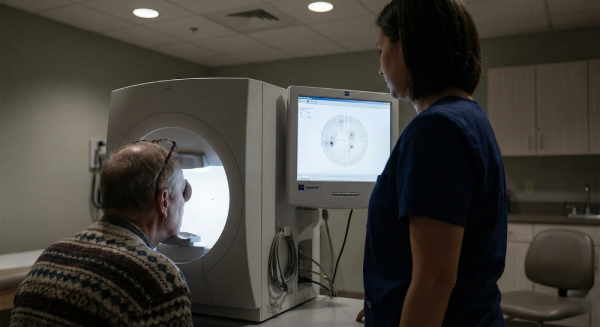
Visual Field Testing: Detects peripheral vision loss. You look at a central point and click when you see lights appear. Shows if glaucoma is affecting your side vision. About 5-10 minutes per eye.
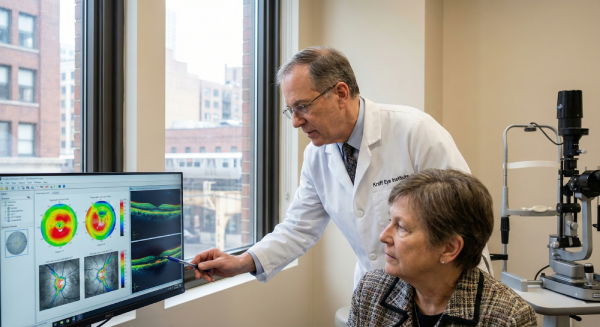
Optic Nerve Imaging (OCT Scan): High-resolution images of your optic nerve. Shows damage not visible in regular exams. Completely non-invasive. Takes detailed measurements. About 5 minutes.
Gonioscopy: Examines the drainage angle inside your eye. Determines if you have open-angle or narrow-angle glaucoma. Uses a special lens on your eye. Quick procedure.
Pachymetry: Measures corneal thickness. Important because thick corneas can give falsely high pressure readings. Thin corneas might read falsely low. Affects treatment decisions.
Dr. Kraff's thorough approach:
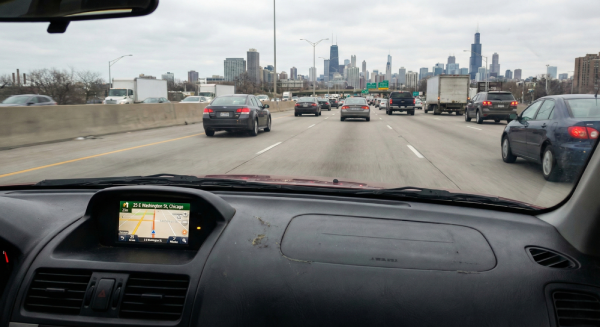
He doesn't rush. Every test gets done properly. The complete exam at our 25 E Washington office takes 60-90 minutes. That's time well spent for an accurate diagnosis.
Equipment advantage:
Our downtown location has diagnostic technology that most suburban offices don't have. Advanced OCT imaging. Precise visual field equipment. State-of-the-art tonometers. Better tools mean better detection.

Medication management (First Line Treatment):
Prescription eye drops lower your eye pressure. Different types work in different ways:
Most patients start here. One drop daily or twice daily, depending on medication.
Laser treatments:
Selective Laser Trabeculoplasty (SLT):
Surgical options for advanced cases:
Trabeculectomy: Creates a new drainage path for fluid. Reserved for glaucoma that doesn't respond to drops or laser. More involved procedure, but very effective.
What research shows:
Studies published in the National Institutes of Health reviewed glaucoma treatment effectiveness systematically. The research confirms that lowering intraocular pressure prevents disease progression. (1) Different patients respond to different treatments. Dr. Kraff customizes your plan based on your specific type and severity.
Treatment goals:
Individualized plans:
Not everyone gets the same treatment. Dr. Kraff looks at:
Why ongoing monitoring matters:
Glaucoma treatment isn't one-and-done. It requires regular follow-ups to ensure treatment is working.
How often you'll visit:
What happens at each visit:
IOP Checks: Every appointment. Quick pressure measurement. Confirms your treatment is controlling pressure.
Visual Field Tests: Every 6-12 months. Tracks any peripheral vision changes. Shows if glaucoma is progressing.
Optic Nerve Scans: Regular OCT imaging. Compares current images to baseline. Detects subtle changes over time.
Medication Adjustments:
Treatment gets modified based on results:
Why compliance matters so much:
Missing doses of eye drops lets pressure rise. High pressure damages your optic nerve. Permanent vision loss follows. Use your drops exactly as prescribed.
The long-term reality:
Glaucoma is a chronic condition. You'll manage it for life. Regular appointments prevent it from stealing your vision.
Dr. Kraff's comprehensive approach:
Highest patient satisfaction comes from thorough care. He tracks every detail. Catches problems early. Adjusts treatment as needed.
Downtown convenience:
All testing happens at 25 E Washington St. One location. Same equipment every time. Consistent measurements. Better tracking of your progression.
From the Woods and Touhy area (Holocaust Museum vicinity):
Parking your car:
Plan for dilated eyes:
Glaucoma exams often include pupil dilation. Bring sunglasses for the drive home. Vision stays blurry for 2-4 hours. Consider having someone drive you.
Dr. Kraff's credentials:
35 years of treating eye diseases. Board-certified by the American Board of Ophthalmology. Member of professional societies, including the American Society of Cataract and Refractive Surgery.
Experience matters with glaucoma:
This disease is tricky. Subtle changes matter. Someone who's monitored thousands of glaucoma patients knows what to look for. Dr. Kraff catches progression other doctors might miss.
Advanced equipment access:
Diagnostic tools at our downtown office surpass what suburban locations offer. Better OCT machines. More precise visual field equipment. Superior tonometry tools.
Comprehensive care in one place:
Medical management. Laser treatments. Surgical options if needed. All available at 25 E Washington St. No referrals to different locations.
Proven outcomes:
Highest patient satisfaction comes from unparalleled care. Patients trust Dr. Kraff with their vision because he delivers results.
Worth the 25-minute drive:
Access to Chicago's leading glaucoma expertise. Better equipment. More experience. That combination protects your vision better than local alternatives.
What patients appreciate:
Personal attention. Thorough exams. Clear explanations. Dr. Kraff treats you like a person, not a number. He knows preserving your vision matters deeply.
Insurance acceptance note:
Most medical insurance covers glaucoma treatment (unlike LASIK, which is elective). However, Kraff Eye Institute does NOT accept EyeMed or Blue View Vision plans.
The honest recommendation:
Glaucoma is serious. Vision loss is permanent. Choose your eye doctor based on expertise and equipment, not just convenience. Your eyesight depends on it.
Kraff Eye Institute serves Skokie patients from our downtown Chicago location at 25 E Washington St, Suite 606, Chicago, IL 60602. Call (312) 444-1111 to schedule your comprehensive glaucoma evaluation and protect your vision with Dr. Kraff's expert care.
Protect your vision with comprehensive glaucoma treatment in Chicago. Don't wait until you notice vision loss - early detection prevents damage. Schedule your evaluation for glaucoma treatment near Illinois Holocaust Museum Skokie today.
To schedule a consultation, please call (312) 444-1111. To inquire about other services, please fill out our Vision Correction Consultation form.
Schedule Consultation


